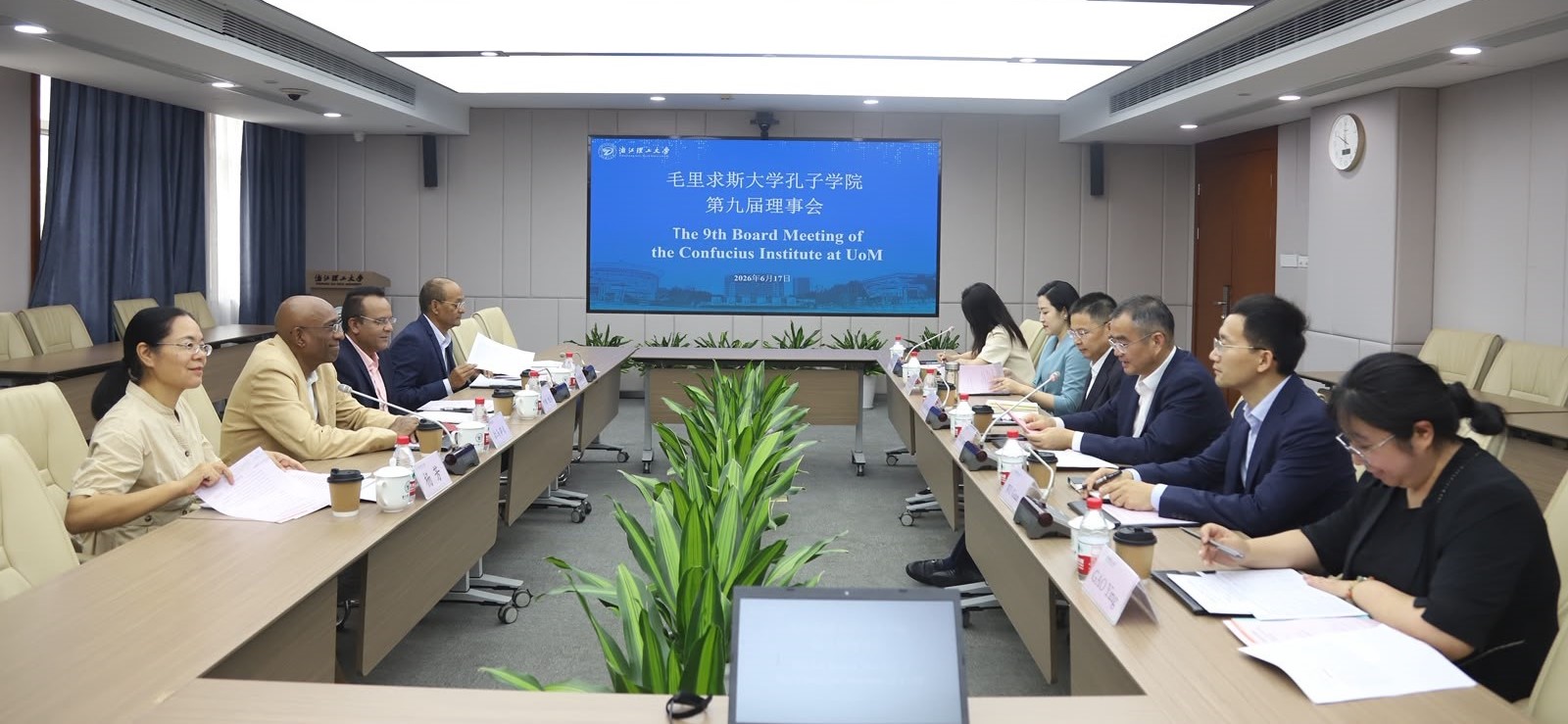
The agreement between Zhejiang Sci-Tech University (ZSTU) and the University of Mauritius was renewed under the same terms and conditions as the previous one, for a period of five years. As stipulated in the agreement, an annual Board meeting is to be held every year, with each institution taking turn to host the meeting. The 9th Annual Board meeting for 2025 was hosted by ZSTU and held on 17th June 2026 at ZSTU campus, Xiasha, Hangzhou, China.
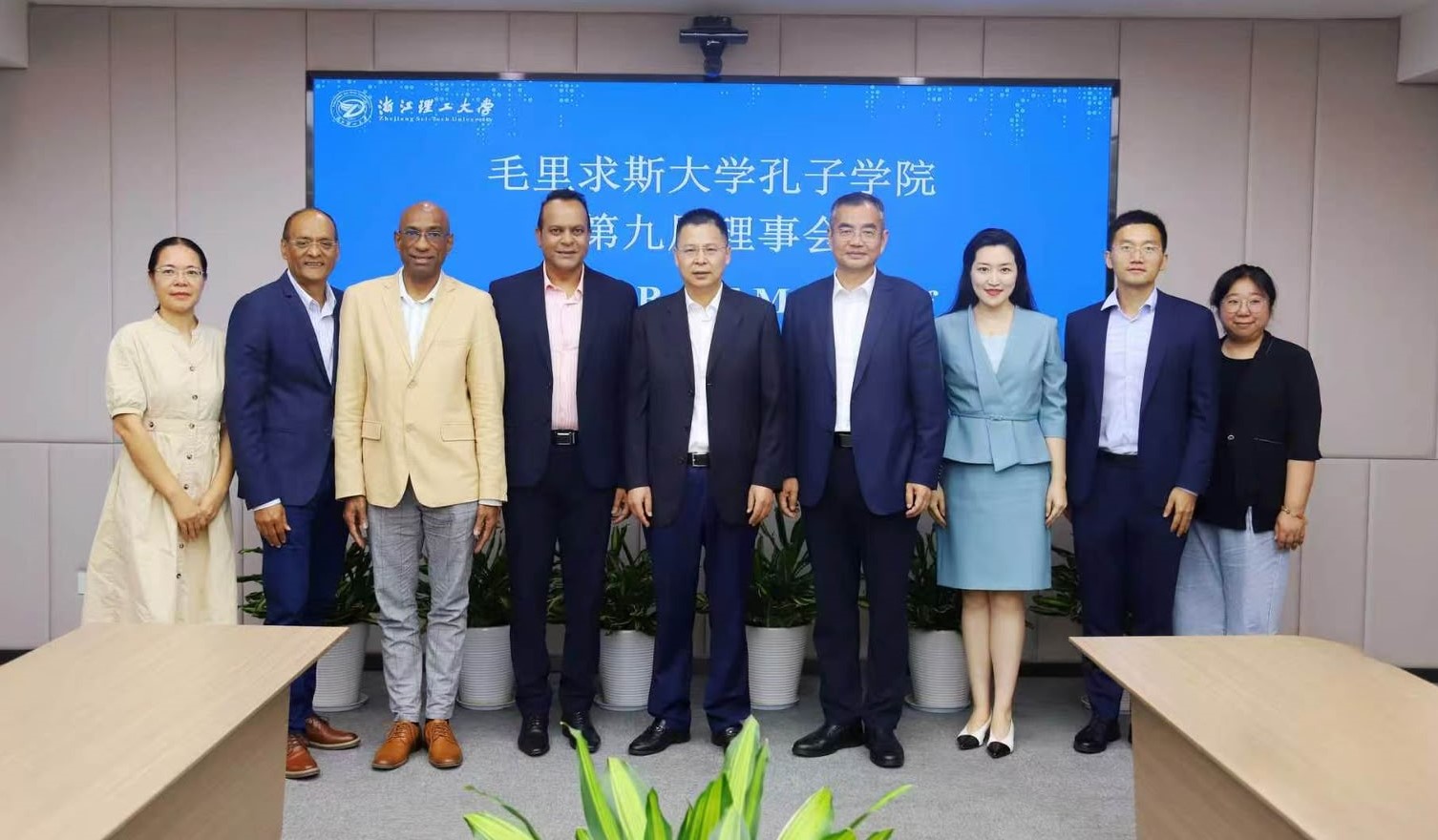
The members of the Board present included Prof. ZHAO Quanjun, the Chinese Chair of CI Board and Chair of Council of ZSTU; Prof. Kavi Kumar KHEDO, the Mauritian Chair of CI Board and Vice Chancellor of the University of Mauritius; Prof. Ponnadurai RAMASAMI, Pro-Vice-Chancellor (Academia), UoM; Prof. YAO Juming, Vice President of ZSTU; Prof. LYU Yuanyuan and Prof. WU Guan, Director and Deputy Director of ZSTU International Exchange & Cooperation Office; Mrs. GAO Ying, Vice-Director of Office of Finance, ZSTU; Assoc. Prof. YANG Fang and Assoc. Prof. Naraindra KISTAMAH, co-Directors of CI-UoM. The meeting was presided over by Prof. ZHAO Quanjun.
Prof. Zhao welcome all the members present and congratulated Prof. Khedo & Prof. Ramsami on their respective appointment as Vice Chancellor and Pro-Vice Chancellor (Academia) of the University of Mauritius. He counts on the support of senior management to further advance the mission of the Confucius Institute at UoM. Prof Zhao acknowledged the achievements of CI-UoM over the past nine years in promoting Chinese language teaching and culture, and facilitating inter-university cooperation. He remarked that ‘Sinology originated in China but belongs to the world’ as stated by President XI Jinping. Prof. Zhao re-emphasized that Confucius Institute should continuously strengthen its activities, and promote scientific research and academic exchanges. He is confident that ZSTU and UoM would promote collaboration further, with the unfailing support of senior management and the Confucius Institute at UoM.
Prof. Kavi Kumar Khedo expressed his thanks to Zhejiang Sci-Tech University for its continuous support to the development of the University of Mauritius and the Confucius Institute. The VC stated that he witnessed the growth of CI-UoM over more than 9 years as an academic staff and now as VC of the University. He bears testimony of the enthusiasm of the Mauritian audience, of all ages and groups, to learn Chinese language & culture and take part in the various activities organized by the Institute. He is very pleased that CI-UoM’s services are extended to all communities, groups, associations and students of other tertiary public universities. He extends his wholehearted support to the sustainable development of CI-UoM and the strengthening of ties between CI-UoM and the local community.
After the remarks by both Chairpersons, all members gave due attention to the 2025 annual work report & 2026 work plan presented by Assoc. Prof. Yang Fang, and the 2025 financial report & 2026 budget presented by Assoc. Prof. Naraindra Kistamah. They reviewed all reports and approved the 2026 work plan and budget. Additionally, other related matters were discussed during the meeting.
During his visit to ZSTU, the VC & PVC of UoM were warmly met by Professor Kong at the School of Materials Science and Engineering. Professor Kong has been working closely with Professor Bhaw-Luximon of CBBR-UoM. Professor Kong expressed keen interest to revive the ZSTU/CBBR-UoM joint research collaboration which was established in 2017 and worked very well for several years. Professor Kong introduced key members of his Faculty and gave a presentation of the high-profile on-going research works in the field of Biomedicines, Biomaterials and Tissue Engineering. After the presentation and discussions, Prof Kong and fellow researchers guided the delegation on a tour of the research facilities of the School. Professor Kong has been invited to meet with representative of EDB and businesses in Mauritius and deliver a persuasive and inspirational presentation in his area of research, from conceptualization to commercialization of relevant products. One of the strength of Professor’s Kong Faculty is that the latter works closely with over a dozen Chinese companies in Hangzhou which turn research ideas into market-ready, profitable products or services. This covers the entire lifecycle of innovation, guiding a new concept through development, refinement, and market launch.
The delegation was also invited to meet the Computational Chemistry Research group which is housed under the Department of Chemistry within the School of Science. The Dean of the School of Science is Prof. Dr. Zhang Yunbo, and the Head of the Department of Chemistry is Prof. He Ping-an. Several key researchers attended the meeting and the head of the Computational Chemistry Research Group introduced the Department and its main activities. Professor Ramasami was pleased to invite the group to participate in the upcoming Virtual Conference on Chemistry and its Applications 2026 (VCCA-2026) with the theme ‘Adapting Research for Societal Needs’, to be held 10th -14th August 2026. He went on to explain VCCA to the group and encouraged the researchers and scientists to join in and disseminate the information to as many researchers of their network in China. Through this initiative, it is hoped that another avenue of collaboration could be explored. Professor Ramasami also mentioned that the office of Computational Chemistry Research group at UoM, housed under the Department of Chemistry within the Faculty of Science, can provide all the support for researchers of ZSTU to apply for grants offered under the VCCA Research Scheme. Professor Khedo also expressed his support for a close collaboration between the two universities in the field of Chemical Engineering.
The VC & PVC were accompanied by the Chinese and Mauritian Directors on an educational tour of ZSTU Campus in Xiasha and its facilities. ZSTU Xiasha Campus is a closed campus with control access points. The campus is quite sprawling and walking is common, but bicycles or electric-powered scooters are quite popular. The access to resources on campus, such as books & special archives at the library, laboratories, and payment at canteens or shops, are facilitated by a smart card. The digital setup works well and provides a lot of convenience to campus life. The ZSTU Silk Museum highlights the university’s textile legacy. It features exhibits on sericulture, historic looms, and fabrics, reflecting ZSTU's deep roots in textile engineering. The Library Information Center is an impressive, modern resource center for the Xiasha Campus, featuring vast collections of books, journals and magazines, and access to e-resources. The modern sports & athletic amenities & Students’ Activity Centre (SAC) serves as the central hub for clubs, events, and administrative services. The Sports & Athletic amenities consist of a swimming pool, gym, and multi-purpose stadium. ZSTU offers on-campus accommodation for all students, dining halls for guests, cafés, shops and canteens for students and staff, offering a variety of cuisines.
The delegation was then invited on a cultural tour of China National Silk Museum, West Lake, and Hefang street in Hangzhou. The China National Silk Museum is the world’s largest silk museum and is located near West Lake in Hangzhou. It is divided into several specialized galleries that showcase a rich tapestry of silk relics through its very long silk history of over 5000 years. The Silk Road Gallery focuses on ancient land and maritime trade routes. It features well-preserved textile relics recovered along the Silk Road, tracing how the fabric traveled globally. The Fashion Gallery explores modern and historic dresses, featuring exquisite qipaos, Western fashion trends over the centuries, and traditional imperial robes from the Han, Ming, and Qing Dynasties. The Weaving Gallery showcases historic, fully operational traditional looms, and complex ancient weaving patterns.
West Lake, inscribed as the ‘West Lake Cultural Landscape of Hangzhou’, is a UNESCO World Heritage Site and was officially declared in June, 2011. It is known for its serene layout which reflects an "idealized fusion between humans and nature,". The key cultural attractions of West Lake are rooted in ancient causeways, pagodas and temples, its highly celebrated green scenery and landscapes, historical architectural additions and romantic Chinese folk legends. One of its main attractions is the largest artificial island in the lake. It features three historic stone pagodas rising from the water (known as the ‘Three Pools mirroring the Moon’), which are famously printed on the back of China's 1-Yuan banknote.
Hefang Street is a bustling pedestrian thoroughfare located just east of West Lake, known for its well-preserved historic street from the Southern Song Dynasty in Hangzhou. It is the city's cultural and commercial walking street, popularly celebrated for its ancient style architecture, century-old traditional Chinese medicine pharmacies, and vibrant street food culture. The pharmacy functions as both a working pharmacy and a fascinating museum of traditional Chinese medicine, housed in a magnificent courtyard complex. Visitors can still see practitioners preparing herbal remedies and tonics. The street is also lined with vendors selling traditional local snacks, such as rice cakes, dumplings, sweets, and other candies. There are tea houses which offer authentic longjing green tea tastings and their sales in endless varieties. There are also live craft demonstrations where artisans practice traditional heritage crafts such as jewel making, micro-engraving, and fan painting.
|
9th Annual Board meeting of CI-UoM at ZSTU, 17th June 2026 |
|
Group photo, from left to right: Mrs Yang Fang, Dr Naraindra Kistamah, Prof. Ponnadurai Ramasami, Prof. Kavi Kumar Khedo, Prof. Zhao Quanjun, Prof. Yao Juming, Prof. Lyu Yuanyuan, Prof. Wu and Mrs Gao.
|