

SDG 10 | Reduced Inequalities
The University of Mauritius is committed to reducing inequalities and building an inclusive academic community where every student and staff member can thrive. UoM works to widen access to higher education for all students, supports learners with disabilities, and maintains policies against discrimination in admissions, employment and campus life. Through its research on social and economic inequality, and its engagement with communities across Mauritius, the University also contributes to fairer national policy and opportunity. This page presents evidence of UoM’s work towards SDG 10.
10.6 Measures Against Discrimination
The University of Mauritius (UoM) admits students on academic merit, and its regulations for academic year 2024/2025 forbids discrimination against any applicant. Diversity and Inclusion is one of the University's stated values.
Equal opportunity in admissions. UoM's Regulations on Recruitment, Selection and Admissions states that, in line with the University's commitment to equal opportunities, no applicant will be treated less favourably on grounds of race, ethnic origin, colour, gender, parental status, marital status, disability status, political belief, or social or economic background. The University recognises the diversity of background, experience and age of applicants.
Fair and consistent selection. All applications are assessed fairly against published academic selection criteria approved by Senate. The Registrar, through the Admissions and Student Records Office, and the Deans must make sure these criteria are applied fairly and consistently. Senate, through its Teaching and Research Committee, reviews recruitment, selection and admission practices.
Positive measures for applicants with disabilities. Chapter 11 of the General Regulations sets out how UoM admits students with disabilities. Offers are based on merit, but where an impairment may have affected an applicant's results, the Admissions Eligibility Committee considers the case individually. Applicants may be contacted or interviewed so that reasonable adjustments can be arranged before they start. UoM commits to offering academic opportunity to all suitably qualified people irrespective of disability. It may decline a qualified disabled applicant only for an overriding health and safety risk, or where essential adjustments cannot be made, and must tell the applicant in good time.
Other routes in. A mature-student entry route and part-time study open the University to people returning to education. Needy students, students from vulnerable groups and students with disabilities can apply for financial help, including the UoM Scholarship Scheme for Disabled Students, which made two awards in 2024/2025.
The Registrar's Office is responsible for monitoring applications, and its remit covers admissions, disability and special-needs support, financial aid, and student progress and completion.
Women. Every applicant's gender is recorded at application, and UoM reports its graduates by gender and level every year. In 2024/2025, women were 1,511 of the 2,239 students who completed their programmes (67.5%).
Students with disabilities. Applicants are asked to declare any impairment on the application form. The Admissions Eligibility Committee considers each such applicant individually and arranges reasonable adjustments before entry. In 2024/2025, the UoM Scholarship Scheme for Disabled Students received two applications.
Low-income students. The Student Welfare Office administers needs-based scholarships and financial aid so that underprivileged students have equitable access to university. In 2024/2025 it received 19 applications to the UoM Students Financial Assistance Fund and made 16 awards. It supported about 305 students on scholarships and financial assistance across the University.
International students. UoM tracks international applications and admissions, including students from developing countries under the Mauritius-Africa Scholarship Scheme. In 2024/2025, 175 new international students were admitted, bringing the total to 369. The University also processed 21 applications from short-term international students, of whom 16 came to UoM.
The University of Mauritius is an Equal Opportunity Employer. The University's Equal Opportunity Policy ensures that all recruitment and selection exercises for appointment and promotion are fair and equitable and will not be determined by the status of employees or prospective employees, including nationality, age, caste, colour, creed, ethnic origin, religion or belief, pregnancy, impairment, marital status, place of origin, political opinion, race, sex and sexual orientation.
The University explicitly encourages applications from persons with disabilities who possess the required qualifications. The University's Recruitment and Selection Guidelines (Staff Handbook, Section 2.6) explicitly states: "The University welcomes applications from all qualified candidates including disabled persons."
To ensure that vacancies reach the widest possible audience, vacancies are normally advertised both internally and externally through adverts circulated via e-mail across the intranet, internal circulars, on the University notice boards, on the University website and also in the local press. For senior posts, advertisements are also placed in international magazines and websites to attract a diverse global pool of talent. Staff members are provided at least two weeks to apply for internal advertisements, and external applicants are given two weeks to one month.
To ensure that the selection process remains fair, unbiased and accessible, the University uses objective selection methods including paper-based aptitude tests, computer-based aptitude tests, proficiency tests, and interviews. Candidates are assessed based on pre-determined criteria such as knowledge of the subject, communication skills, leadership skills, performance at interview, qualifications, and seniority. This ensures that all applicants, regardless of their background, are evaluated solely based on their ability to fulfil the job requirements.
For more information:
https://www.uom.ac.mu/images/FILES/policies/UoMEqualOpportunityPolicy.pdf
The University of Mauritius is committed to the principle of equality of opportunity for all staff and students and to providing an environment where respect is shown to all. The University of Mauritius (UoM) is committed to developing and maintaining a working environment which is conducive to staff effectively undertaking their roles. As a community, the University is committed to support, develop and promote equality and diversity, in all of its practices and activities; while aiming to establish an inclusive culture, free from discrimination and based on the values of dignity, courtesy and respect. The UoM recognizes the right of every staff to be treated in accordance with these values and as per the rule of law.
Policy Framework
The University's Equal Opportunity Policy, approved by Council on 17 November 2015, states that the University is committed to ensuring that:
• There is equity, fairness and transparency in all policies and practices;
• Employees are treated with respect and work in an environment free from discrimination in any form;
• Everyone is offered the same opportunities for employment, training and promotion.
The policy prohibits discrimination on the grounds of nationality, age, caste, colour, creed, ethnic origin, religion or belief, pregnancy, impairment, marital status, place of origin, political opinion, race, sex and sexual orientation.
Section 6 of the University of Mauritius Act 1971 expressly prohibits discrimination on account of nationality, race, caste, religion, place of origin, political opinions, colour, creed or sex in:
• Appointment to academic or other staff;
• Registration as a student;
• Graduation or holding any advantage or privilege of the University.
The University's Code of Ethics/Conduct (Staff Handbook, Section 3.11) reinforces this commitment:
"The University is committed to the principle of equality of opportunity for all staff and students and to providing an environment where respect is shown to all, and where all staff and students, regardless of their gender, race, colour, ethnic background, culture, (dis)ability, sexual orientation, age, religion, socio-economic status or any other factors, are valued and encouraged to perform to their full potential. No discrimination based on the above factors will be tolerated."
Enforcement and Disciplinary Measures
To guarantee a safe and inclusive environment, the University's Rules and Procedures for Discipline (Staff Handbook, Chapter 7) explicitly classify: "Acts of discrimination, bullying, harassment and/or victimisation of members of staff, students or visitors to the campus which compromise a person's dignity" as Gross Misconduct.
Any staff member found guilty of such acts will face formal disciplinary action, which may include demotion, suspension, or dismissal.
Grievance Procedures
Staff who feel they have been subjected to discrimination can lodge a formal complaint under the University's Grievance Procedures (Staff Handbook, Section 7.1). The procedure guarantees fairness, allows the complainant to be accompanied by a trade union representative at formal stages, and includes a clear right of appeal to the Staff Committee.
The University's core values of respect, integrity, academic freedom, diversity, inclusion, social responsibility and institutional autonomy underpin its commitment to non-discrimination.
For more information:
https://www.uom.ac.mu/images/FILES/AboutUs/UoMAct1971.pdf
https://www.uom.ac.mu/hr/index.php/policies-procedures/equal-opportunity-policy
The University of Mauritius is committed to promoting diversity, equity, inclusion and human rights on campus. The Director of Human Resources and the Office of Human Resources are responsible for diversity and equality matters at the University. The University's Equal Opportunity Policy (2015) sets out the framework for ensuring equity, fairness and transparency in all policies and practices. The policy is implemented by the Pro-Vice-Chancellor (Planning & Resources), the Director of Human Resources, and Heads of Section, who have responsibility for day-to-day implementation, review and monitoring. Trainings are also organised by the Office of Human Resources in collaboration with the Equal Opportunities Commission (EOC).
The University of Mauritius collaborated with the Equal Opportunities Commission to conduct the second and third session of EOC’s sensitization campaign on Equal Opportunity on 04 April 2025 and on 29 August 2025 for University of Mauritius staff. The objective was to prevent discrimination from occurring by informing people about their rights and responsibilities under the Equal Opportunities Act through these campaigns as well as through preparation of appropriate codes and guidelines.
For more information:
https://www.uom.ac.mu/images/FILES/policies/UoMEqualOpportunityPolicy.pdf
The University of Mauritius provides support to students, staff and faculty from underrepresented groups through a range of measures.
Staff Development:
• The University provides facilities to all staff to apply for international scholarships so that they can upgrade their qualifications (Staff Handbook, Section 2.5).
• All staff are provided with opportunities to attend workshops, seminars and conferences locally and internationally.
• Staff benefit from short courses organised by the University and other institutions on Safety and Health, First Aid, Customer Service, Writing Skills, Communication Skills, and other topics.
• Knowledge-sharing talks by eminent personalities are organised on a monthly basis.
Grievance Procedures:
• The University has a formal Grievance Procedure (Staff Handbook, Chapter 7) that provides a platform for staff to address work-related issues in a fair and timely manner.
• Staff may be accompanied by a trade union representative at discussions with management.
Staff Unions:
• The University recognises three unions: (1) University of Mauritius Academic Staff Union (UMASU), (2) University of Mauritius Staff Union (USU) and (3) University of Mauritius Technicians’ Union (UTU) (Staff Handbook, Section 8.1).
• The University and the Unions engage constructively to develop conditions conducive to harmonious employment relations.
The University is committed to strengthening mentoring, counselling and peer support programmes for underrepresented groups.
The University of Mauritius is committed to promoting equality, inclusiveness and non-discrimination by ensuring that its campus facilities and services are accessible to persons with disabilities. In line with SDG 10, the University recognises the importance of eliminating physical and institutional barriers that may hinder the full participation of persons with disabilities in campus life.
As part of its commitment to equal opportunity and inclusive education, the University endeavours to provide an accessible and supportive environment through progressive improvement of its physical infrastructure and facilities management. Measures include the provision of accessible and covered pathways, ramps, reserved parking, wheelchair-accessible entrances, lifts and accessible sanitary facilities, where applicable. Attention is also given to the accessibility of teaching rooms, lecture theatres, library and other common areas to facilitate safe and convenient movement throughout the campus.

Ramp to facilitate access to buildings
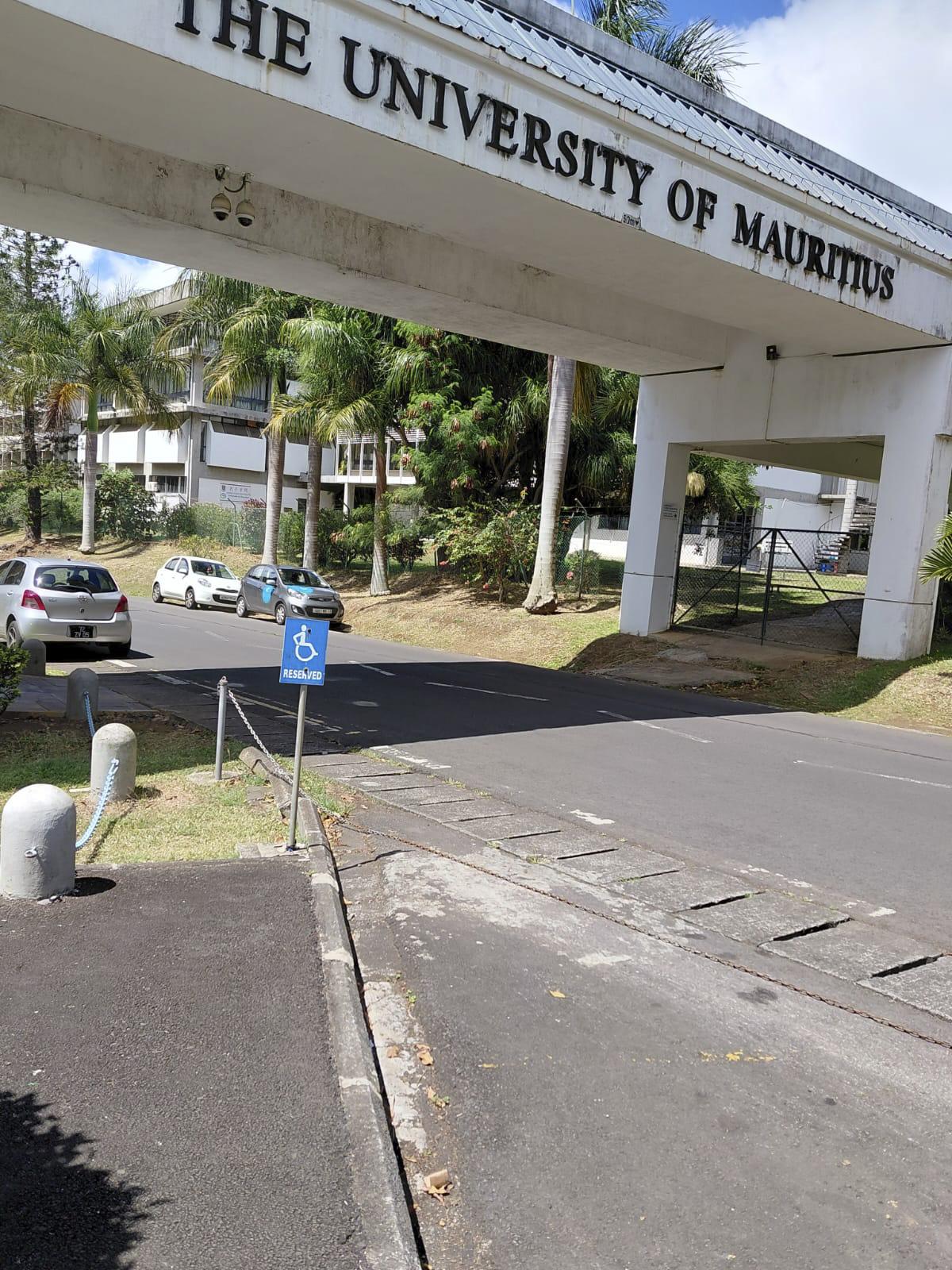
Reserved Parking Facilities
The University of Mauritius (UoM) provides support to students with disabilities in accordance with Chapter 11 of its Student Regulations for Academic Year 2024-2025. The provisions aim to promote equitable access to higher education through reasonable adjustments based on individual needs. Support may include accessible facilities such as ramps and lifts, appropriate classroom allocation and timetabling, adapted teaching approaches, and special examination arrangements, including additional time of up to 25%, alternative examination formats and the use of computers where appropriate. The University Library may also provide extended loan periods, private study facilities and assistance with locating resources. These arrangements apply to both undergraduate and postgraduate students, with the objective of facilitating their participation in academic activities while maintaining academic standards.
For more information:
https://www.uom.ac.mu/images/FILES/Regulations/2024_2025/chap11.pdf
Chapter 11 of the UoM Regulations for Academic Year (2024/2025) provides information about the disability access scheme at the UoM. It applies to all undergraduate and postgraduate students with physical, medical, mental health or learning disabilities. Admissions are assessed case by case so that reasonable adjustments can be made. Support includes accessible infrastructure such as ramps and lifts, needs-based timetabling, library assistance, and special examination arrangements such as extra time, alternative formats and assistive technology.
For more information:
The University of Mauritius provides reasonable accommodation for people with disabilities, set out in Chapter 11 (“Students with Disabilities”) of its General Regulations, in force for the academic year 2024/25 and reissued each year. In line with Article 2 of the UN Convention on the Rights of Persons with Disabilities, the University makes the necessary and appropriate modifications and adjustments, based on individual need, so that people with disabilities can take part in university life on an equal basis with others.
Accommodations provided:
• Physical: covered ways, lifts and ramps, and room allocation adapted to the individual’s needs.
• Academic: adapted timetabling and teaching delivery, and special examination arrangements, including extra time (up to 25%, with more approved by the Registrar), alternative formats, use of computers, alternative timing and rest days between examinations.
• Library: extended loans, private study space, a fetching and carrying service and help in locating materials.
• Emotional and mental health: students are referred to counsellors, emotional support services and psychologists through the Admissions and Student Records Office.
• Employment-related: Through an MoU with Absa Bank signed in June 2025, students with disabilities are also offered internships, work placements and training.
Funding. The University Scholarship Scheme for Disabled Students covers the annual administrative fee for undergraduates and general fees for postgraduates; the 2025/26 call was issued on 12 September 2025.
Responsibility and complaints. Faculties and Centres arrange accommodations, the Registrar decides exceptional cases, and the Student Welfare Office administers financial support. Complaints are handled through the University’s complaints procedure.
The University of Mauritius values the diversity of its staff and students and strives to provide a working environment in which all members can participate fully and equally in an atmosphere free from all forms of harassment, exploitation, or intimidation.
The University of Mauritius Anti-harassment policy states the following:
Definition of Harassment:
• Harassment is defined as such behaviour where a person is subjected to unwanted conduct, which has the purpose (intentionally), or effect (unintentionally) of violating that person's dignity or creating an intimidating, hostile, degrading, humiliating or offensive environment for that individual.
• Harassment takes many forms, including sexual and racial harassment, bullying as well as any other form of personal harassment or victimisation arising from disability, sexual orientation, identity or expression, socio-economic status, age, religion, etc.
Sexual Harassment:
• Sexual harassment is defined as unwelcome sexual advances, requests for sexual favours, and other verbal or physical conduct of a sexual nature when:
o submission to or rejection of such conduct is made implicitly or explicitly a term or condition of instruction, employment, or participation in University activity;
o submission to or rejection of such conduct by an individual is used as a basis for evaluation in making academic or other decisions affecting an individual;
o such verbal or physical conduct has the effect of unreasonably interfering with an individual’s work or academic performance, by creating an intimidating, hostile, or offensive environment.
The University will take action, including disciplinary procedures, against any form of harassment. Harassment by University employee(s) on student(s) over whom they have authority is particularly serious.
Reporting Mechanism
• Staff who feel they are being subjected to harassment may first wish to deal with the issue informally.
• If unresolved, staff should fill in a complaint form and submit it to the Vice-Chancellor /Pro-Vice-Chancellor/Chief of Facilities and Services/Registrar/Dean/
• All complaints are dealt with confidentially, effectively and as quickly as possible.
• Complaints against the Vice-Chancellor should be addressed to the Chairperson of Council.
Grievance Procedures:
In line with Chapter 7 of the Staff Handbook, staff have the right to escalate complaints to the next reporting line if the accused is their supervisor. Staff also have the right to be accompanied by a trade union representative during discussions with management.
Enforcement and Disciplinary Action:
The University takes immediate action against any form of harassment. Under Chapter 7 of the Staff Handbook (Section 7.2), the University explicitly classifies "Acts of discrimination, bullying, harassment and/or victimisation of members of staff, students or visitors to the campus which compromise a person's dignity" as Gross Misconduct.
• Harassment by University employee(s) on student(s) over whom they have authority is treated with particular seriousness.
• Any staff member found guilty of harassment will face formal disciplinary procedures, which may include demotion, suspension, or dismissal. The accused retains the right to appeal any disciplinary decision under the Staff Handbook.
Legal framework:
• Incidents of harassment may mean individuals are liable to prosecution in courts of law under either civil or criminal legislation.
• Nothing in the Code of Ethics/Conduct prevents members of staff from exercising their legal rights.
The University's Equal Opportunity Policy also provides that staff members who feel they have been subject to discrimination, victimisation or harassment should report the matter to their Immediate Supervisor or Head of Section/Department.
National Legislation:
The University strictly adheres to Part XI (Section 114) of the Workers' Rights Act 2019, which addresses "Violence at Work". The Act makes it an offence to harass, sexually or otherwise, assault, verbally abuse, bully, or use threatening behaviour towards a worker.
Furthermore, Section 114(4) mandates that an employer shall enquire into any case of alleged violence at work and take appropriate action to protect the rights of the worker not later than 15 days after the case is reported. The University's internal grievance procedures comply fully with this legal requirement.
For more information:
UoM Staff Handbook (Section 3.9 and Chapter 7)
https://www.uom.ac.mu/hr/